
One of the most uncomfortable things I’ve learned recently is how much I want to be understood.
Not agreed with.
Not validated.
Understood.
And perhaps even more uncomfortable was realizing how powerless I felt when I couldn’t create that understanding.
As a therapist, I spend much of my time helping people feel understood. I ask questions. I explore meaning. I challenge assumptions. I stay curious.
Yet a recent experience reminded me of something surprisingly humbling:
Understanding cannot be forced.
I can explain myself.
I can clarify my intentions.
I can ask better questions.
I can invite curiosity.
But I cannot make another person become curious about my experience.
And if understanding requires curiosity, that is a difficult reality to accept.
The experience left me wondering:
Recently, while trying to repair a friendship, I came face-to-face with that question.
A Conversation About a Word
I was trying to repair a friendship after trust had been damaged.
We had plans to meet for coffee and talk about what happened and how to move forward.
Before we met, something extremely valuable and important to my friend became available during the time we were supposed to meet.
The issue wasn’t that I didn’t understand why they made the choice they did.
I did.
If I were looking through their eyes, I would have made the same decision.
What I wanted to discuss wasn’t the decision. It was the impact.
The situation affected both of us, and I was trying to figure out what happens next.
How would we adjust?
How would we move forward?
How would decisions affecting both of us be handled while trust was being rebuilt?
At one point, I used the word negotiation.
Little did I know how much trouble that word was about to cause.
To me, negotiation meant:
“Let’s figure out a way forward together.”
What seemed to be heard was:
“Your decisions require my approval.”
We spent far more time discussing the word than the meaning behind it.
Looking back, they could have called it a croissant for all I cared.
The word wasn’t the point.
The meaning was.
And I didn’t fully understand at the time why the conversation felt so difficult.
Now I think I do.
We Don’t Hear Words. We Hear Meaning.
Or perhaps more accurately:
We hear the meaning we’ve assigned to the words.
Words matter. But relationships are built on shared meaning, not shared vocabulary.
One person hears: “Negotiation.” Another hears: “Control.”
One person hears: “Space.” Another hears: “Rejection.”
One person hears: “Compromise.” Another hears: “Losing myself.”
The challenge is that we rarely stop to ask:
“What does that word mean to you?”
Instead, we assume.
And assumptions are surprisingly convincing.
The Knowing That Kills Curiosity
One of my favourite questions to ask clients is:
When you think you know without confirming, do you really know?
The moment we think we understand, curiosity begins to fade.
We stop asking.
We stop exploring.
We stop summarizing.
We stop checking.
Instead, we start filling in the blanks.
I know what they meant.
I know why they said that.
I know what they’re really thinking.
Maybe.
But did we check?
Or did we simply become certain?
I’ve started to believe that many relationship struggles begin here.
Not with disagreement.
With certainty. With the “I know”.
Because certainty feels a lot like understanding.
But they’re not the same thing.
Curiosity Requires Humility
The uncomfortable truth is that curiosity requires something many of us dislike.
Humility.
It requires acknowledging that there may be something we don’t yet know.
Something we haven’t yet understood.
Something we haven’t yet asked.
Curiosity sounds like:
“Can you tell me more?”
“What did you mean by that?”
“Help me understand.”
“When you say that, what are you hoping I’ll hear?”
These questions sound simple.
But they are powerful.
Because every question delays a conclusion.
And every delayed conclusion creates another opportunity for understanding.
The Part That Caught Me Off Guard
If I’m honest, I recognized much of this in the moment my friend and I were talking.
I recognized we weren’t talking about the same thing.
I guessed we were attaching different meanings to the conversation.
I knew I was trying to explore while they were trying to protect.
What I didn’t fully appreciate was how much I needed to be understood.
In the therapy room, I am acutely aware that my personal opinions, beliefs, preferences, and ways of living have very little weight.
Therapy is not about convincing clients to adopt my perspective. It’s about understanding theirs.
I am comfortable sitting beside different beliefs, different values, and different ways of seeing the world. In many ways, that is what I do every day.
Yet in the context of this friendship, I discovered something uncomfortable.
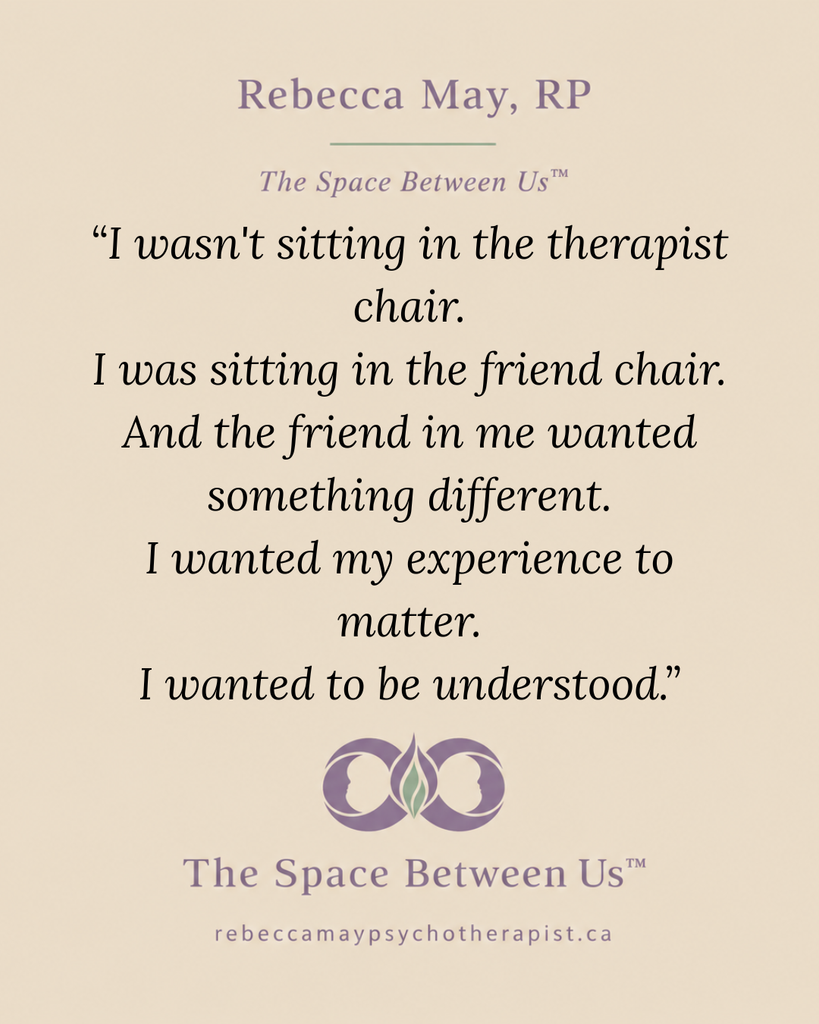
I wasn’t sitting in the therapist chair.
I was sitting in the friend chair.
And the friend in me wanted something different.
I wanted my experience to matter. I wanted to be understood.
I wanted the meaning behind my words to be explored.
I wanted my perspective to receive the same curiosity I was trying to offer theirs.
And when that wasn’t happening, I felt the loss of connection more deeply than I expected.
Not because they agreed or disagreed with me.
Because I didn’t feel understood.
That realization humbled me.
Because even after years of helping people navigate relationships, I am still human.
And humans long to be understood by the people who matter to them.
Understanding Is Not Agreement
I think this is where many relationships become stuck.
People assume that if they understand another person’s perspective, they are agreeing with it.
Or worse, abandoning their own.
But understanding is not agreement.
Understanding is understanding.
I can understand why your experience makes sense to you without making you right and me wrong.
I can understand your perspective without abandoning my own.
I can become curious about your reality without losing myself.
Yet many conversations become trapped in an invisible tug-of-war.
If I understand you, I lose. If you understand me, you lose.
As though understanding is a limited resource that only one person can possess at a time.
The irony is that connection requires the opposite.
Not less curiosity. More.
Not less exploration. More.
Not certainty. Understanding.
The Space Between Us™
For years, I believed that if I explained myself clearly enough, other people would understand.
Now I’m not so sure.
I’ve learned that understanding is not something we deliver. It’s something we create.
Together.
I’ve learned that people can hear every word I say and still attach a different meaning to those words. I’ve learned that curiosity cannot be forced. And I’ve learned that understanding another person’s perspective does not require abandoning your own.
Perhaps that is where many relationships become stuck. We fear that understanding someone else means agreeing with them.
Or worse, losing ourselves.
But understanding is not agreement. Understanding is simply a willingness to explore another person’s reality.
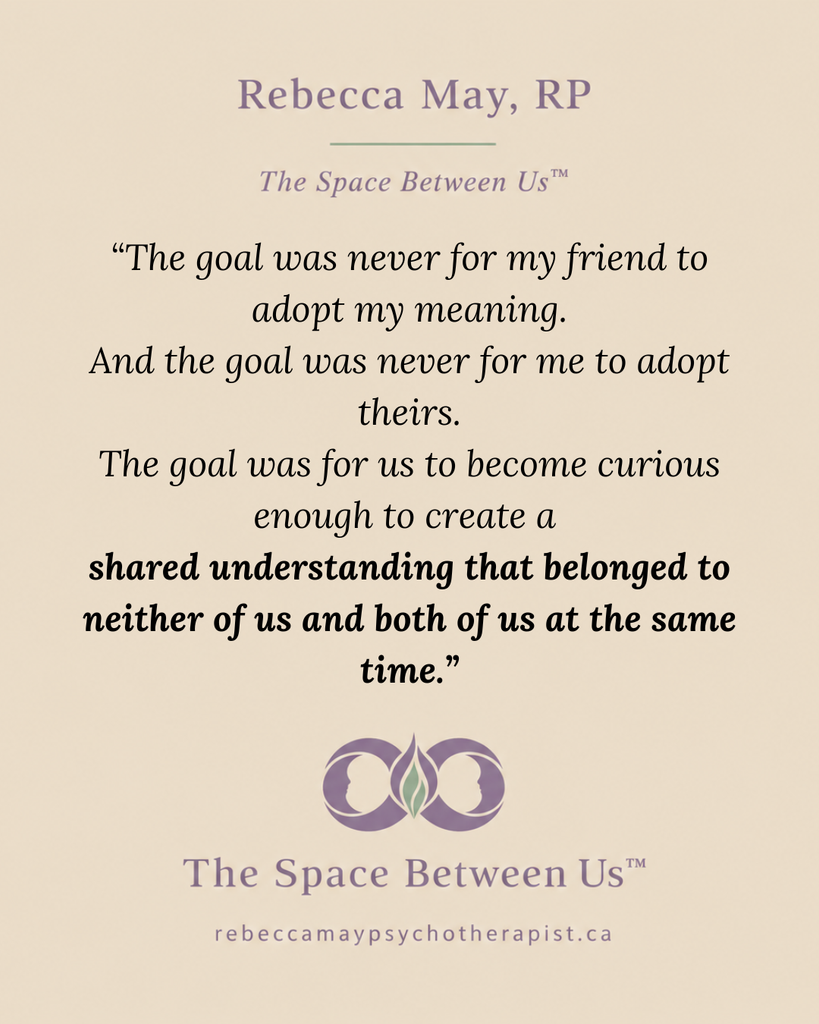
The goal was never for my friend to adopt my meaning. And the goal was never for me to adopt theirs. The goal was for us to become curious enough to create a shared understanding that belonged to neither of us and both of us at the same time.
Because connection does not happen when one person wins the meaning. Connection happens when two people become curious enough to create meaning together.
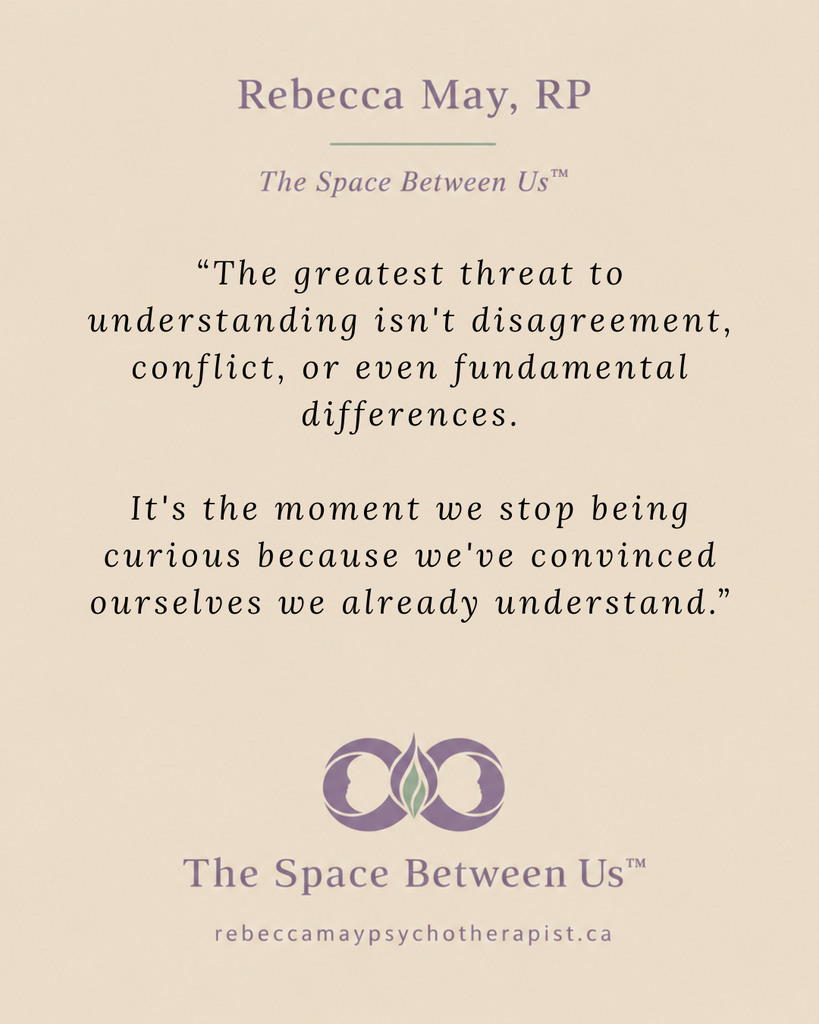
And perhaps that’s why the greatest threat to understanding isn’t disagreement, conflict, or even fundamental differences.
It’s the moment we stop being curious because we’ve convinced ourselves we already understand.
Understanding is not something we find. It’s something we create together in the space between us.
Leave a Reply